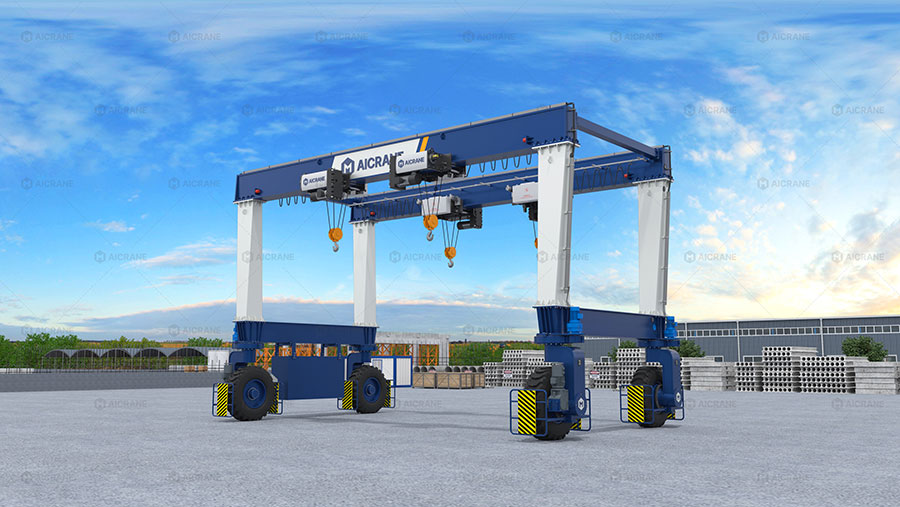
The Rubber Tyred Gantry (RTG) crane is a cornerstone of modern container terminals and industrial yards. Its most distinctive advantage over rail-mounted alternatives lies in the rubber tyre travelling system, which enables flexible, rail-free movement while carrying heavy loads.
To clearly understand its value, this article presents the rubber tyre travelling system features of rubber tire cranes in a well-defined hierarchical structure, moving from core concepts to detailed technical characteristics and operational benefits.
1. Overview of the Rubber Tyre Travelling System
1.1 Definition and Role
The rubber tyre travelling system is the mechanism that allows an RTG crane to move across the yard using heavy-duty rubber tyres instead of steel wheels on rails. It includes tyres, wheel assemblies, drive units, steering mechanisms, braking systems, and control logic.
1.2 Why It Is a Core RTG Feature
This system directly determines:
-
Yard layout flexibility
-
Crane mobility and positioning accuracy
-
Pavement requirements
-
Operating efficiency and lifecycle cost
Without the rubber tyre travelling system, the RTG would lose its defining advantage of free movement.
2. Rail-Free Mobility Features
2.1 Operation Without Fixed Infrastructure
A fundamental feature of RTG travelling systems is rail-free operation. The mobile gantry cranes move directly on concrete or asphalt pavement, eliminating the need for rails, sleepers, and alignment work.
2.2 Benefits for Yard Planning
This feature enables:
-
Flexible container block arrangement
-
Easy yard expansion or reconfiguration
-
Lower initial civil construction investment
Terminals can adapt quickly to changes in cargo volume or operational strategy.
3. Heavy-Duty Rubber Tyre Design Features
3.1 High Load-Bearing Capacity
RTG tyres are specially designed industrial tyres capable of supporting:
-
Crane self-weight
-
Rated lifting loads
-
Dynamic forces during acceleration and braking
Each tyre is engineered with high ply ratings and reinforced internal structures.
3.2 Optimized Ground Contact
Rubber tyres provide a larger contact area than steel wheels, which:
-
Reduces ground pressure
-
Protects yard pavement
-
Improves overall travelling stability
This makes RTGs suitable for long-term operation on reinforced surfaces.
4. Multi-Wheel Configuration Features
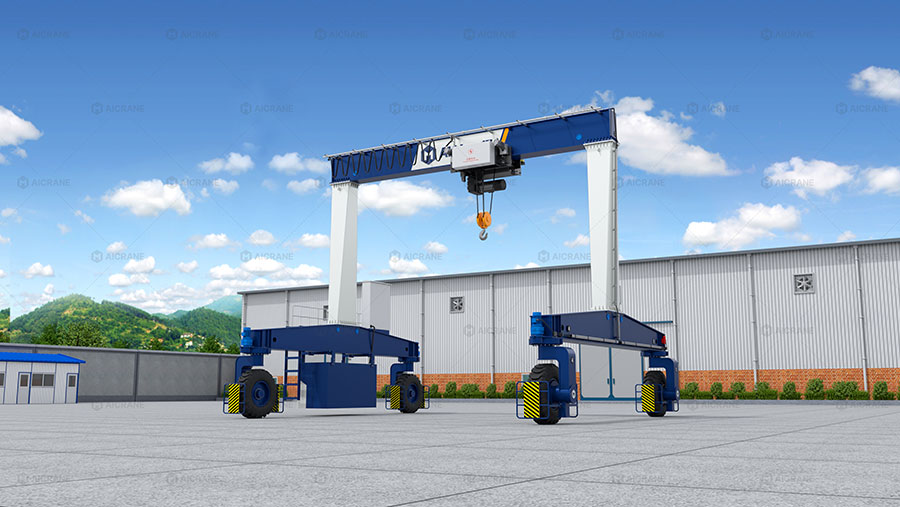
4.1 Typical Wheel Arrangements
RTG cranes commonly use:
-
8-wheel configurations for smaller RTGs
-
12-wheel or 16-wheel configurations for higher capacities
4.2 Load Distribution Advantages
Multiple wheels evenly distribute loads across the ground, which:
-
Minimizes local pavement stress
-
Enhances gantry crane stability
-
Reduces structural fatigue
This feature is critical for heavy-duty container handling.
5. Steering System Features
5.1 Multi-Mode Steering Capability
The rubber tyre travelling system supports multiple steering modes, including:
-
Straight-line steering for long-distance travel
-
Ackermann steering for smooth turning
-
Crab steering for lateral movement
-
Pivot or zero-radius steering for tight spaces
5.2 Precision Positioning
These steering features allow RTG cranes to:
-
Accurately align with container rows
-
Reposition efficiently between blocks
-
Operate in confined yard layouts
High steering precision directly improves yard productivity.
6. Drive and Speed Control Features
6.1 Independent Wheel or Axle Drives
Most RTG travelling systems use electric motor drives, often with one motor per wheel or axle. This allows:
-
Balanced torque distribution
-
Improved traction control
-
Redundancy in case of component failure
6.2 Variable Speed Control
With variable frequency drives (VFDs), the system provides:
-
Smooth acceleration
-
Controlled deceleration
-
Stable low-speed movement
These features are essential when travelling with suspended loads.
7. Anti-Skid and Traction Control Features
7.1 Adaptation to Outdoor Conditions
RTG cranes operate in open environments where surfaces may be wet, dusty, or uneven. Rubber tyre travelling systems include anti-skid features such as:
-
Wheel speed monitoring
-
Torque limitation control
-
Automatic traction adjustment
7.2 Safety and Tyre Protection
These features:
-
Prevent wheel slip during braking or turning
-
Improve crane controllability
-
Reduce abnormal tyre wear
This results in safer and more reliable operation.
8. Stability Features During Travel
8.1 Stability With and Without Load
The travelling system is designed to maintain stability:
-
During unloaded repositioning
-
While travelling with containers lifted
Wide wheel spacing and optimized tyre characteristics minimize the risk of tipping or excessive sway.
8.2 Controlled Braking Performance
Advanced braking systems ensure:
-
Short stopping distances
-
Even braking forces across wheels
-
Stable crane behavior under emergency stops
Stability during braking is a key safety requirement.
9. Shock Absorption and Vibration Reduction Features
9.1 Natural Elasticity of Rubber Tyres
Rubber tyres inherently absorb shocks caused by:
-
Pavement joints
-
Minor surface irregularities
This reduces vibration transmission to the crane structure.
9.2 Structural Protection Benefits
Shock absorption helps:
-
Extend steel structure fatigue life
-
Protect mechanical components
-
Improve reliability of electrical systems
It contributes to long-term durability of the RTG wheeled gantry crane.
10. Noise Reduction Features
10.1 Comparison With Rail-Based Systems
Rubber tyre travelling systems generate significantly less noise than steel wheel rail systems.
10.2 Environmental and Operational Benefits
Lower noise levels:
-
Improve operator comfort
-
Reduce environmental impact
-
Support compliance with port noise regulations
This feature is increasingly important for terminals near urban areas.
11. Maintenance and Serviceability Features
11.1 Easy Inspection and Replacement
Tyres can be:
-
Inspected visually
-
Replaced individually
-
Maintained without dismantling major structures
This minimizes crane downtime.
11.2 Predictable Maintenance Cycles
Tyre wear is gradual and predictable, allowing:
-
Planned maintenance
-
Lower unplanned shutdown risk
-
Better spare parts management
12. Adaptability to Different Yard Conditions
12.1 Pavement and Site Adaptation
By selecting suitable tyre specifications and wheel layouts, RTG travelling systems can adapt to:
-
Different pavement strengths
-
Slight slopes or gradients
-
Mixed operational surfaces
12.2 Application Flexibility
This adaptability makes RTGs suitable for:
-
Container terminals
-
Steel yards
-
Logistics and intermodal facilities
13. Contribution to Overall RTG Performance
The rubber tyre travelling system directly influences:
-
Crane mobility
-
Yard utilization efficiency
-
Operating safety
-
Total cost of ownership
When combined with modern control and automation technologies, it supports high-throughput, flexible, and future-ready RTG operations.
Conclusion
The rubber tyre travelling system is a defining feature of RTG cranes and a major reason for their widespread adoption. Through rail-free mobility, advanced steering, stable load handling, shock absorption, and low maintenance requirements, this system delivers unmatched flexibility and efficiency.
A well-designed rubber tyre travelling system not only enhances day-to-day operations but also ensures long-term reliability, safety, and cost-effectiveness. For ports and industrial yards seeking adaptable and high-performance lifting solutions, understanding these travelling system features is essential for selecting the right RTG crane configuration.